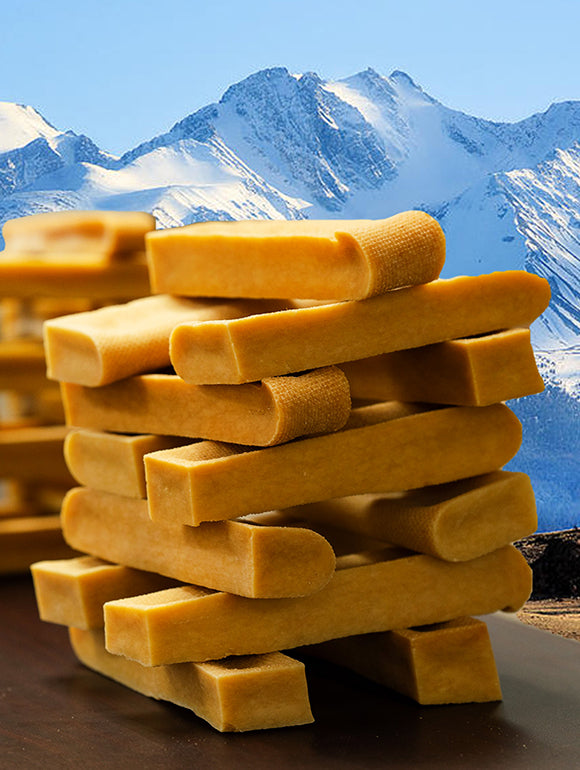
What Is Chhurpi? The Himalayan Cheese Behind Yak Chews


Ever looked at a Himalayan dog chew and wondered how a piece of cheese became that hard? The story started long before Chhurpi found its way into pet stores.
Chhurpi is a traditional Himalayan dairy food made in soft and hard forms. Research from Nepal and the Western Himalayas documents versions made from milk including yak, cattle, buffalo, and yak-cattle crossbreeds. The hard form is dried for longer-term storage. Today, Chhurpi is exported internationally as a dog chew.
What is Chhurpi?

Chhurpi also written as Churpi or Chhurpe is a traditional fermented cheese associated with Himalayan communities. A 2024 study of Chhurpe from the Western Himalayas describes it as a fermented cottage cheese and distinguishes soft and hard varieties.
Chhurpi is not simply another name for a dog treat. It belongs to a wider dairy tradition with different milk sources, textures, and regional methods.
Quick Chhurpi Check
- Origin: Himalayan dairy tradition
- Milk: May include yak, cattle, buffalo, or yak-cattle crossbreeds
- Forms: Soft and hard
- Traditional role: Human food; hard Chhurpi is also chewed over time
- Modern role: Hard Chhurpi is exported as a dog chew
Where does Chhurpi come from?
Chhurpi is strongly associated with Himalayan mountain communities. A peer-reviewed study of Nepal’s Chhurpi trade describes it as an indigenous fermented milk-based cheese typically made in Nepal’s mountain region.
Turning fresh dairy into a firmer, drier food offered longer storage. Research describes hard Chhurpe as sun-dried and stored for long-term consumption.

Is Chhurpi always made from yak milk?
No. The phrase “yak cheese” can easily create that impression.
Research on Nepalese Chhurpi documents milk from female yaks, cows, buffaloes, and chauris, which are yak-cattle crossbreeds. So “Chhurpi” does not automatically mean “100% yak milk.”
For Yak & Paws specifically, the Unflavored Himalayan Yak Cheese Dog Chew lists yak and cow milk plus lemon juice. That is a manufacturer-specific product fact, not a definition of every Chhurpi made across the Himalayas.
What is the difference between soft and hard Chhurpi?

Chhurpi is not always the rock-hard piece dog owners recognize. The 2024 Chhurpe study describes two main varieties: soft Chhurpe is consumed relatively soon after processing, while hard Chhurpe is sun-dried and stored for longer-term consumption.
The researchers note that hard Chhurpe has traditionally been used as a chewing gum or masticator. That dense form helps explain how Chhurpi could later move into the dog-chew market.
How did Chhurpi become a dog chew?
An old food tradition found a new audience. A 2023 study in the Journal of Ethnic Foods reports that Chhurpi is exported worldwide as a dog chew in cubes and sticks.
Chhurpi was not invented for dogs. Pet-chew use is a newer commercial chapter in a much older Himalayan food tradition. Yak & Paws says its hard cheese chews are made in Nepal and Germany.
How is Chhurpi made into a Himalayan dog chew?
At a high level, milk is turned into curds with a natural acid, the curds are pressed to remove moisture, and the cheese is dried and hardened. Methods vary by region and producer.
For the step-by-step version, read How Are Yak Cheese Chews Made? A Step-by-Step Look.

What makes Chhurpi different from an ordinary cheese treat?
The clearest difference is its form. Hard Chhurpi is dried into a dense product meant to be worked slowly rather than eaten in a quick bite.
Questions about protein, fat, minerals, and calories belong in the Himalayan Dog Chew Nutrition guide. Digestion, tooth safety, puppy suitability, swallowed pieces, and sizing are better handled in the dedicated Yak & Paws Safety Cluster instead of squeezing every yak-chew question into one page.
Next time your dog settles down with a supervised chew, you will know there is more behind that little block than its hardness. Explore Yak & Paws Himalayan Yak Cheese Dog Chews to see how the traditional Chhurpi idea is used in today’s hard dog chews.
References
- Choudhary, S., Shanu, K., Hegde, A. S., et al. (2024). Nutritional quality and microbial diversity of Chhurpe from different milk sources: an ethnic fermented food of high-altitude regions of the Western Himalayas. Discover Food, 4, 10. Available at: https://doi.org/10.1007/s44187-024-00073-z
- Panta, R., Paswan, V. K., Kanetkar, P., et al. (2023). Exploring trade prospects of Chhurpi and the present status of Chhurpi producers and exporters of Nepal. Journal of Ethnic Foods, 10, 1. Available at: https://link.springer.com/article/10.1186/s42779-022-00165-0
- Yak & Paws (n.d.). Unflavored Himalayan Yak Cheese Dog Chew. Available at: https://www.yakandpaws.com/products/unflavored-dog-chew
- Yak & Paws (n.d.). How Are Yak Cheese Chews Made? A Step-by-Step Look. Available at: https://www.yakandpaws.com/blogs/news/how-are-yak-cheese-chews-made-a-step-by-step-look
Frequently asked questions
Is Chhurpi the same as yak cheese?
Not exactly. Yak milk can be used, but documented Chhurpi traditions include cow, buffalo, and yak-cattle crossbreed milk.
Is Chhurpi made only in Nepal?
No. Chhurpi belongs to broader Himalayan food traditions, though Nepal has a strong production and export association.
Can people eat Chhurpi?
Yes. Chhurpi is documented as an indigenous fermented milk-based cheese for human consumption; its international dog-chew market developed later.
Why is hard Chhurpi used for dog chews?
Hard Chhurpi is dried for longer-term storage, creating the dense form associated with slow chewing. Nepalese Chhurpi is now exported worldwide as a dog chew.